
Open file, not a war diary — Western copy now runs two opposite sentences about the same war. One: Chinese groups fed Iran satellite pictures and dual-use parts, and Iranian drones started landing closer to U.S. ships and bases. Two: a Chinese HQ-9B battery in Iran “crumbled” under U.S. and Israeli strikes, so Chinese air defence is finished. Both cannot be a single verdict on “China in the Iran war.” They are claims about different objects. This piece keeps those objects apart and walks through how each one is supposed to work.
Beijing has not acknowledged a combat deployment. The useful public record is Iranian customs paper read by the Wall Street Journal, flight-tracking on Mahan Air, and U.S. officials speaking anonymously to CNN and the Journal. Treat those as dated allegations. They are not a PLA order of battle in Tehran.
1. A Short Timeline So the Headlines Stop Floating
U.S. wrap-ups circulating in late September 2026 put the current war’s start on 28 February. A temporary ceasefire is dated 17 June in the Journal’s customs story — the same day a Chinese aircraft is described as landing in Tehran with electronics for the defence ministry. On 17 July, Iranian ballistic missiles hit housing at Muwaffaq Salti Air Base in Jordan; three U.S. troops were killed. By late September, CNN was reporting that Iranian shots at shipping in the Strait of Hormuz had become more accurate over “the past several months,” and that U.S. escorts in one operation had faced more than a dozen missiles and nearly twenty drones.
Those four dates matter because they stop a common cheat: treating a 2025 oil-for-SAM rumour, a June cargo flight, a July strike, and a September intelligence leak as one continuous “Chinese intervention.” They are four different papers stapled together.
2. Layer One — Components: How a Factory Stays Alive When Ports Are Squeezed
The Journal, working from Iranian customs through the end of June 2026, counted about 1,300 air shipments to Iran’s defence ministry that it labelled dual-use. The packing lists, as published, are not finished batteries. They are GPS modules, electric motors, aircraft-engine parts, and electronics that can sit in a Shahed-class airframe or a missile seeker. Two days after the 17 June landing, more than a dozen further consignments arrived; the paper put that cluster at over $6 million in drone-usable parts.
The air-bridge is the mechanism. Mahan Air, already under U.S. sanctions, is described as lifting China–Iran frequencies from about four flights a week in early March to about twenty-seven by late April. Times of Israel, repeating the Journal, called it a near sevenfold jump after the war began. Later September tracking still showed China–Iran legs running well above the pre-war baseline, some of them cargo-heavy. That is how you keep an existing Iranian production line in motors, seekers and airframes when a naval blockade makes the sea route expensive or closed. It is not how you deliver an HQ-9 brigade. A brigade needs radars, trucks, trained crews and a fire-control language. A customs field labelled “electric motor” needs a bench in an Iranian workshop.
An earlier, separate strand belongs on the same shelf: shipping data cited in 2025 reporting that Iranian vessels had lifted more than a thousand tonnes of sodium perchlorate — a precursor for solid-rocket oxidiser — from China in February and March of that year. CSIS voices quoted around the Journal piece said Chinese firms were still marketing the kind of electronics that show up in Shahed drones, and that chemical inputs for solid propellant sat in the same trade. Dual-use is doing real work here. It is also doing rhetorical work: every motor can be written as a missile, and not every motor is one.
3. Layer Two — Pictures: Why a Heat-Seeking Drone Suddenly Looks Smart
CNN on 25 September, citing four people familiar with U.S. assessments, said Chinese geospatial data improved Iranian timing against shipping in Hormuz and was a factor in the Jordan strike. The Journal had already reported high-resolution imagery of Salti both before and after 17 July. Officials in that file stop short of saying the Chinese government ordered the attack. They also, in later wrap-ups, had Rubio saying the imagery had not changed the war’s trajectory. Those two American sentences are allowed to stand together: more precise harassment is not a new front.
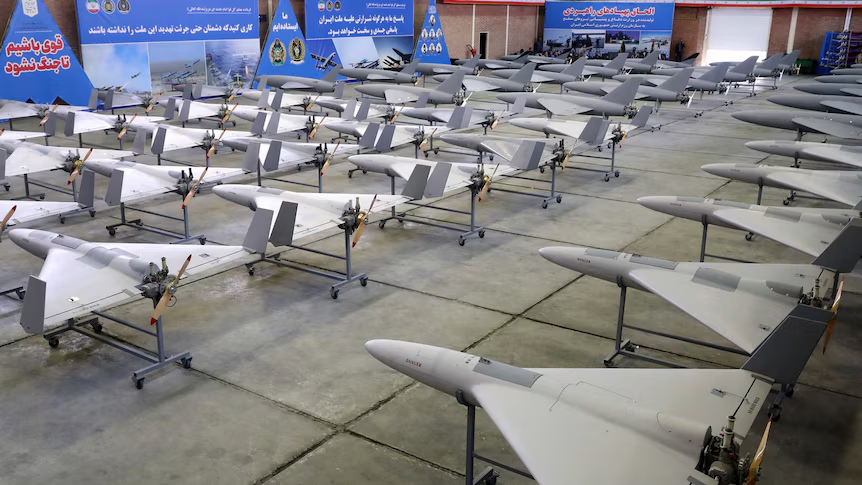
The mechanism is ordinary, which is why it is easy to over-write. Many of the drones in the Hormuz file are described as heat-seeking and not steer-able once they leave the rail. They cannot be walked onto a moving escort in flight. What they can use is a better opening solution: where the ship is, which way it is pointed, when the heat source will be in the seeker’s cone. Satellite revisit plus a human or a simple script that picks a launch minute is enough to turn a stupid airframe into a tighter first shot. That is an intelligence product sitting on top of an Iranian missile. It is not a Chinese battery lighting up an F-35.
Beijing’s public line, as reported in the same week, was to demand evidence and reject the accusation. The open file does not name the company that sold the pictures. Until it does, “Chinese groups” is doing a lot of work in the American sentence — commercial vendors, military institutes, or something in between. For a defence-industry reader that distinction is the whole story. For a columnist it disappears.
4. Layer Three — Finished Weapons: The Sale That Keeps Being Announced and Denied
HQ-9B entered the Iran file in 2025. Middle East Eye, picked up by Army Recognition on 8 July 2025, cited Arab intelligence sources saying batteries had arrived after a de facto ceasefire with Israel on 24 June 2025, paid in oil. An Iranian lawmaker, Abolfazl Zohrevand, was quoted saying China would supply HQ-9 to close high-altitude gaps. Beijing denied a HQ-9B delivery. That denial is still on the page in 2026 Indian and trade-press recaps. It has not been replaced by a ministry confirmation, a battery photograph with a readable serial, or a fire-control radar tied to a named raid.

Reuters in July 2026 reported a different, smaller object: Iran expecting a first batch out of up to 400 Chinese shoulder-fired launchers, $60–70 million, possibly overland via Pakistan. Beijing denied that too. Shoulder-fired missiles are a roof over a hangar, not a theatre shield. If they arrived, they belong in the last-ditch layer with Tor, Pantsir and Iranian guns. They do not license a headline that “China’s long-range air defence failed.”
The collapse-headline industry — RNA, some Indian dailies, Defence Innovation Review — treated a strike package that reached nuclear sites and leadership compounds as a factory test of HQ-9B. Iran’s reconstructed grid is mixed: S-300 variants, Bavar-373, Khordad-15, short-range Russian and Iranian systems, and a reported Chinese long-range layer. A package that gets through proves the national net did not hold. It does not isolate which radar died first, whether interceptors were left in the can, or whether an HQ-9B battery was powered. That is the same category error as scoring PLA HQ-9 off a Venezuelan JY-27A sitting next to a Russian S-300.
5. Two Scorecards That Should Not Be Added
Attack scorecard (stronger file). U.S. officials say Iranian low- and medium-altitude shots got better. Customs data and the air-bridge give that claim a physical path: motors, GPS, pictures, time to train. CNN’s own sources added that American high-altitude missile defence is built for a different problem than the cheap layer now arriving in volume. None of that requires a Chinese officer in an Iranian launch cell.
Defence scorecard (weaker file). “HQ-9B crumbled against F-35” needs a battery that is documented in the fight. The public record still has a denied sale, a mixed grid, and damage that can be explained by empty magazines, broken cueing, too few sites, or electronic attack on Russian and Iranian radars. Until someone publishes the kill chain, the defence scorecard is a headline.
Adding the two scorecards into one sentence — “Chinese weapons failed, therefore China is not a peer” — is what the Washington Examiner did on 29 September. The addition is the error. Parts and pictures can make an Iranian drone less stupid in the same month that an unconfirmed SAM fails to save a compound. Those are not the same product and not the same customer command net.
6. What the File Still Does Not Show
- PLA combat units, ships or aircraft in the fight.
- A Chinese government admission that it sold HQ-9B to Iran.
- A public, battery-level kill chain: this Chinese radar, this night, this Chinese missile.
- Proof that every dual-use line in the customs field was fitted into a weapon rather than mixed civilian stock.
- The name of the entity that sold the Jordan-base imagery.
What it does show is a pattern Beijing has used with other sanctioned customers: keep the client’s own factories and rockets alive with parts, oxidiser precursor and pictures; stay off the battlefield; deny the finished long-range SAM. Offensively, U.S. officials say that pattern made Iranian shots less random. Defensively, nobody has published the test that would let you grade an Eastern Theatre HQ-9 brigade.
Bottom line
China’s measurable footprint in this war, on present open sources, is a supply-and-sensing footprint. The part that is easiest to count — 1,300 dual-use air shipments through June, a Mahan surge, alleged imagery of a Jordan base — sits on the Iranian attack line and has a mechanism you can describe in a paragraph. The part Western columns most like to fail — HQ-9B versus F-35 — is the part that is least documented as having been in the fight at scale. Recalibrate: write “components and pictures, contested SAMs, no PLA brigade.” Do not write “the PLA fought in Iran and lost.” Do not write the opposite either. The open file is not that kind.
Sources: Wall Street Journal via Times of Israel, Jerusalem Post and IranWire, 23–24 September 2026 (1,300 shipments through June, 17 June flight, Mahan Air frequencies, Salti imagery); CNN, 25 September 2026 (geospatial assessments, Hormuz escort numbers, air-defence assistance as a separate clause); Reuters, July 2026 (reported MANPADS package and denial); Army Recognition citing Middle East Eye, 8 July 2025 (reported HQ-9B / oil barter); Economic Times, Times of India, RNA and Defence Innovation Review 2026 (HQ-9B-failure headlines); 2025 shipping notes on sodium perchlorate; Chinese official denials as carried in those pieces. Counts and dates are as published, not independently audited here.